 Family of Sites
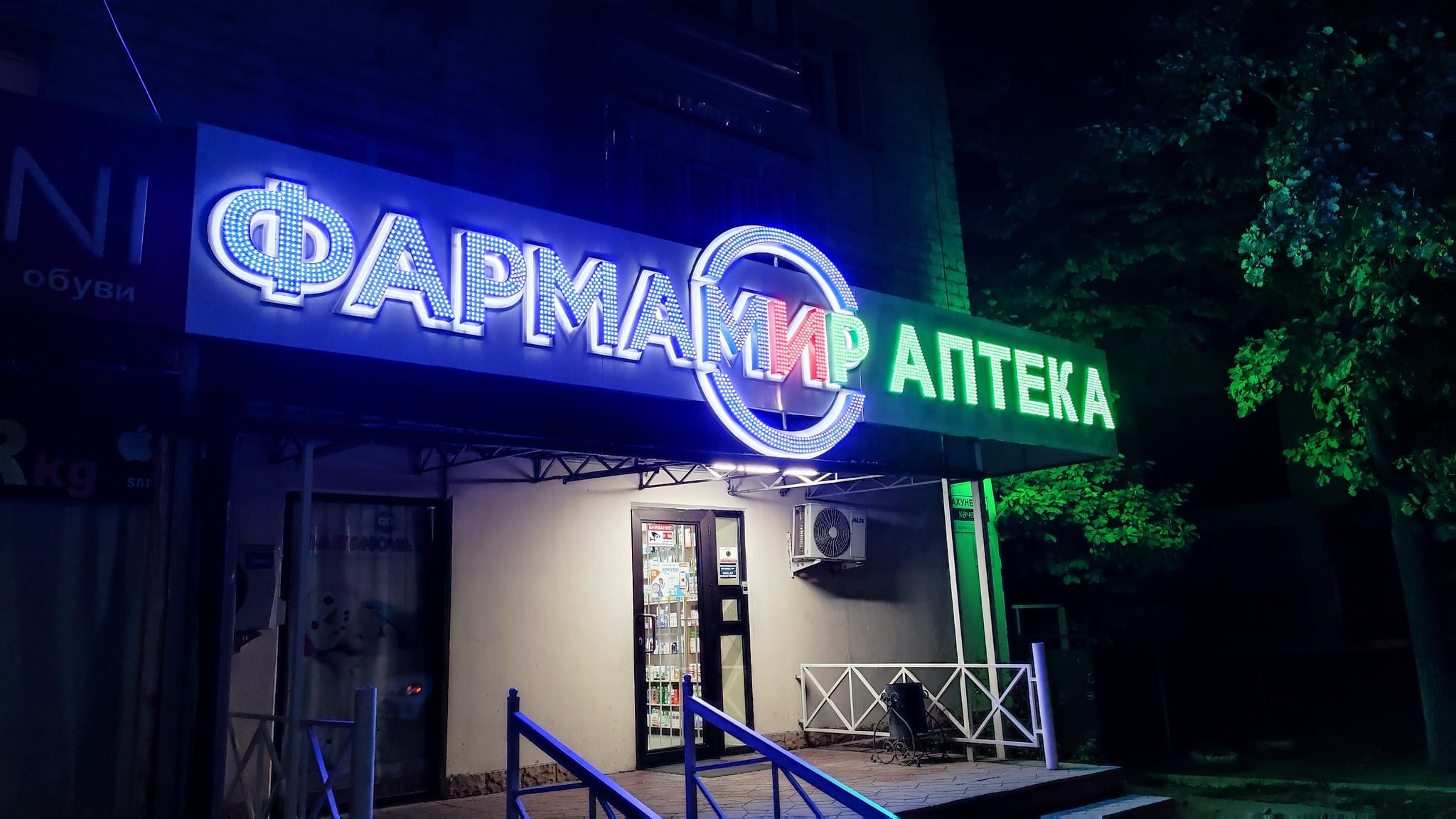
Healthcare abroad is often different from what we’ve experienced at home. How doctors and homestay facilitators may react to certain illnesses is different. Medicines and procedures that can be prescribed by doctors are often different. Over-the-counter brands that can be recommended by pharmacists are often different. Home remedies offered by friends or homestay facilitators can seem downright magical – but often work.
In all SRAS locations, SRAS offers its students translation assistance if they require healthcare while on one of our programs. Additionally, in most locations, doctors and pharmacists are available that speak either English or Russian as second languages. The resource below is provided to assist students in understanding the Russian they may hear when seeking healthcare abroad.
Treating Common Illnesses: Russian Vocabulary
Hopefully, students coming abroad will not face any проблемы со здоровьем (health problems), but this might happen. Students then need to лечиться (treat (that illness)). They may need записаться на прием к врачу (to make an appointment with a doctor) and сходить к врачу (to go to see the doctor). Often, a first visit to the doctor starts with seeing a терапевт (general practitioner).
All students on SRAS programs abroad will have медицинское страхование (medical insurance) either through SRAS or their school. Some clinics abroad can accept this insurance directly. In any case, students should keep any квитанции и документация (receipts and documentation) for their records in case they need to file a claim later.
Doctors and Pharmacies
In a кабинет врача (doctor’s office) the пациент (patient) is often first asked “На что жалуетесь?” (“What is bothering you?”). The patient can say “Я плохо себя чувствую” (‘I am not feeling well’), and then elaborate – “У меня болит голова/живот/горло” (‘I have a headache/stomachache/sore throat’), or “У меня сильная простуда” (“I have a bad cold”). Perhaps the patient will have something that often affects people who have just traveled long distances and say, “У меня расстройство желудка и диарея” (“I have an upset stomach and diarrhea”).
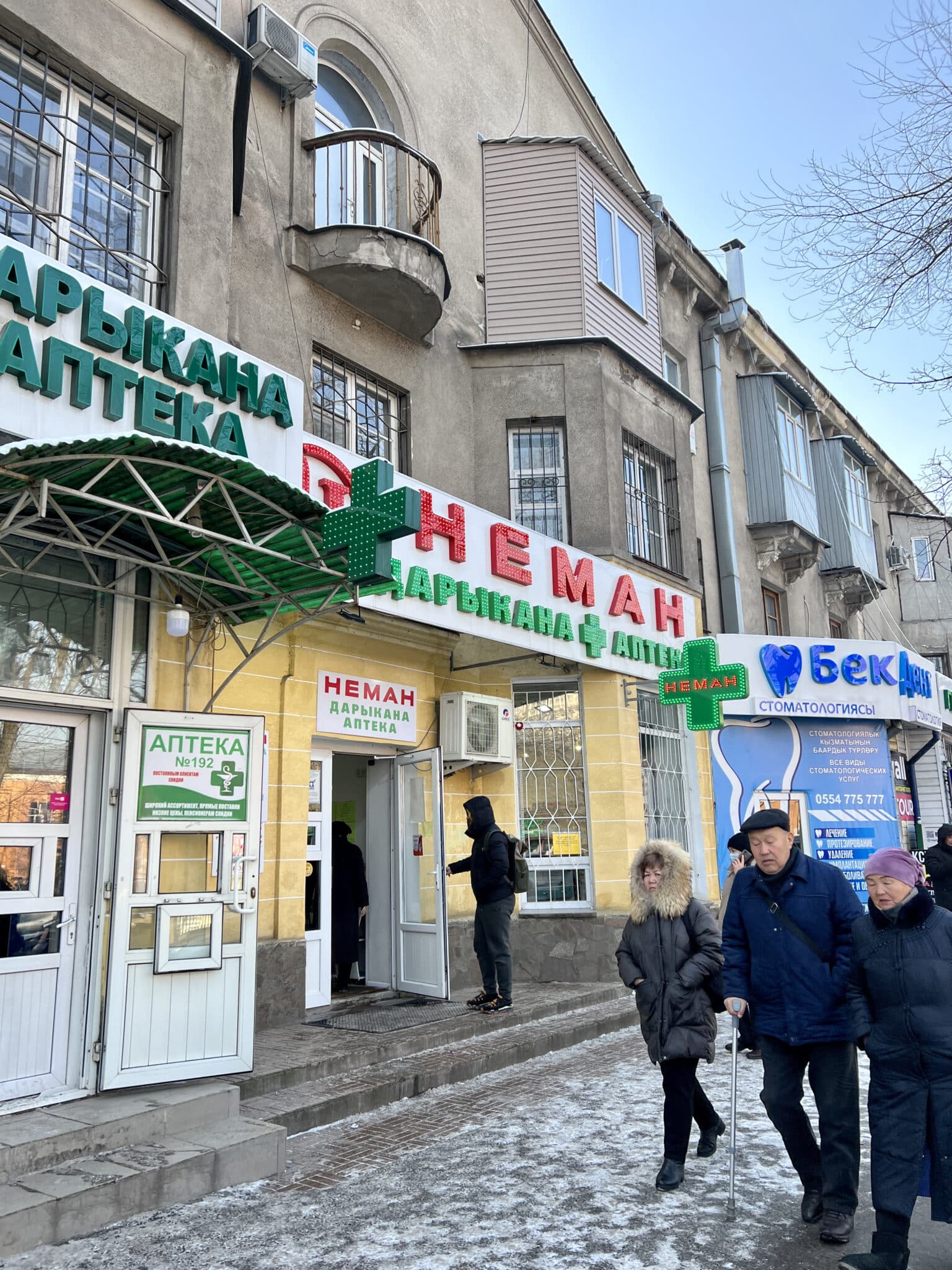
The doctor will осмотрит больного (examine the sick person) and usually выпишет лекарства/терапию (prescribe some medicine/treatment).
Medicine often has to be taken до еды (before meals) or после еды (after meals). Most medicine is regimented as well, for example, по одной таблетке три раза в день (one tablet three times a day).
Some medications will require a рецепт (prescription). These might include антибиотики (antibiotics) or противовирусные препараты (antiviral medications).
Many treatments will involve medicines that are продаваемые без рецепта (over-the-counter) and do not require prescriptions. От головной боли (for headaches), the doctor can prescribe анальгетики (painkillers). Чтобы сбить температуру (to bring down a temperature), аспирин (aspirin) is often prescribed.
In many locations, medicines, whether prescription or over-the-counter, will need to procured from an аптека (pharmacy). Medicines are not available in most grocery stores as they are in the US. Some medications will have побочные явления (side effects) as these should be understood fully before taking the medicine.
If a person has грипп (the flu), he/she can be recommended medicines such as парацетамол (Paracetamol) or колдрекс (Coldrex), which are both brands common in many SRAS locations.
For treating diarrhea, one can dissolve two or three small crystals of марганцовка (potassium permanganate) in a half liter of water to produce a dark pink, but not violet, solution. One glass is drank in the morning and another at night. Usually, only two doses are prescribed. Another common over-the-counter stomach treatment is Энтеросгель. A heaping tablespoon of the thick, grainy gel is taken by mouth. It is designed to expand to clear the stomach and intestines as it moves through your system.
Doctors in this part of the world will often also prescribe витамины (vitamins) to aid healing or recovery. They might also request that certain foods be eaten with the medicine prescribed. For instance, антибиотики (antibiotics) might be followed with a spoonful or two or sour cream, which acts as a пробиотик (probiotic) and can alleviate the upset stomach that antibiotics might cause.
Dentistry
To prevent cavities, dentists around the world recommend that you come in for regular гигиеническая чистка зубов (hygienic teeth cleaning), also sometimes referred to in Russian as a профессиональная чистка зубов (professional cleaning). Some foreign visitors to стоматологическая клиника (dentist offices) in Russian-speaking areas of the world may be surprised that медсестра надевает маску пациенту (the nurse will put a mask on the patient) before обдувка песком (sandblasting), a common method to clean teeth in many parts of Europe, the Caucasus, and Central Asia. Before this process, the area will undergo обезболивание/анестезия с помощью геля (anaesthetization by means of a gel) as it can be uncomfortable for the patient. Some bleeding after the procedure is normal.

If you have зубная боль (a toothache), you will need to get лечение зубов (dental treatment). A dentist office is most often known in Russian as a стоматологическая клиника (dental clinic). They come in many forms from the государственная клиника (state clinic) which is generally known for бесплатные услуги (free services) for local citizens to a частная клиника (private clinic). In many places, these private clinics are more often associated with лечение по мировым стандартам (treatment according to international standards) and usually for более высокие цены (higher prices).
Prior to лечение (treatment), стоматолог (a dentist) обследует зубы (examines your teeth) to find the дупло (cavity), or any other problems, such as налет (plaque) or зубной камень (tartar). A больной зуб (painful tooth) will have the area around it undergo обезболивание/анестезия с помощью укола (anaesthetization by means of injection). Once the участок зуба (tooth area) замораживается (is anaesthetized), the стоматолог (dentist) can удалять нерв (extract the nerve) and очищать кариозную полость (clean out the decaying cavity).
While the стоматолог очищает зубную полость (dentist cleans out the tooth cavity), a медсестра (nurse) applies a вакуумная воздуходувка (suction; literally a ‘vacuum blast engine’) to откачивание слюны (pump out saliva).
It is possible, especially at state clinics, for a временная пломба (temporary filling) to be put into the cavity for a day or two, then она заменяется постоянной пломбой (it is replaced with a permanent filling). After установка пломбы (installing a filling), it is шлифуется (polished).
When a зуб (tooth) невозможно вылечить (is impossible to cure), it is удаляется (extracted) or вырывается (pulled out), using зубные щипцы (dental forceps).
If a student abroad has to find лечение зубов (dental treatment), whether using государственная клиника (a state clinic) or частная клиника (a private clinic), they will probably find the service just as effective and much less expensive (if paid for out of pocket) than similar services in the US although it may come with a bit of культурный шок (culture shock).
Glasses and Eye Doctors
An eye doctor is called an “окулист” or “офтальмолог” in Russian, or, sometimes and informally, a “глазной врач.” Meanwhile, “оптика” is the standard word for an eyeglasses shop.
One can записаться на прием к окулисту (make an appointment with an eye-doctor) to проверить зрение (have/get your eyes checked) or для проверки зрения (for an eye exam). An eye doctor can выписать рецепт на очки (write a prescription for glasses). Regarding prescriptions, the system is the same as in other parts of the world, such as in the US: for example минус пять (-5.0), плюс четыре семьдесят пять (+4.75), etc. in increments of 0.25. To describe your vision, you say у меня очки на минус (I have glasses for nearsightedness) or у меня очки на плюс (I have glasses for farsightedness).
Like in English, Russian uses a slightly brusque expression, четырехглазый (“four-eyed”), to refer to people wearing glasses. Teasing bespectacled people is common at schools, which is why many teenagers стесняться носить очки (are ashamed to wear glasses) and prefer to wear контактныелинзы (contact lenses) to disguise that they are близорукий (nearsighted) or дальнозоркий (farsighted). In addition, in recent years Russian TV has created the image of a «ботаник» в очках (“nerd” wearing glasses), which is a нудный человек (boring person) who is good at studies, but otherwise awkward.
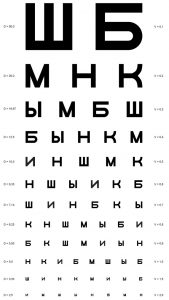
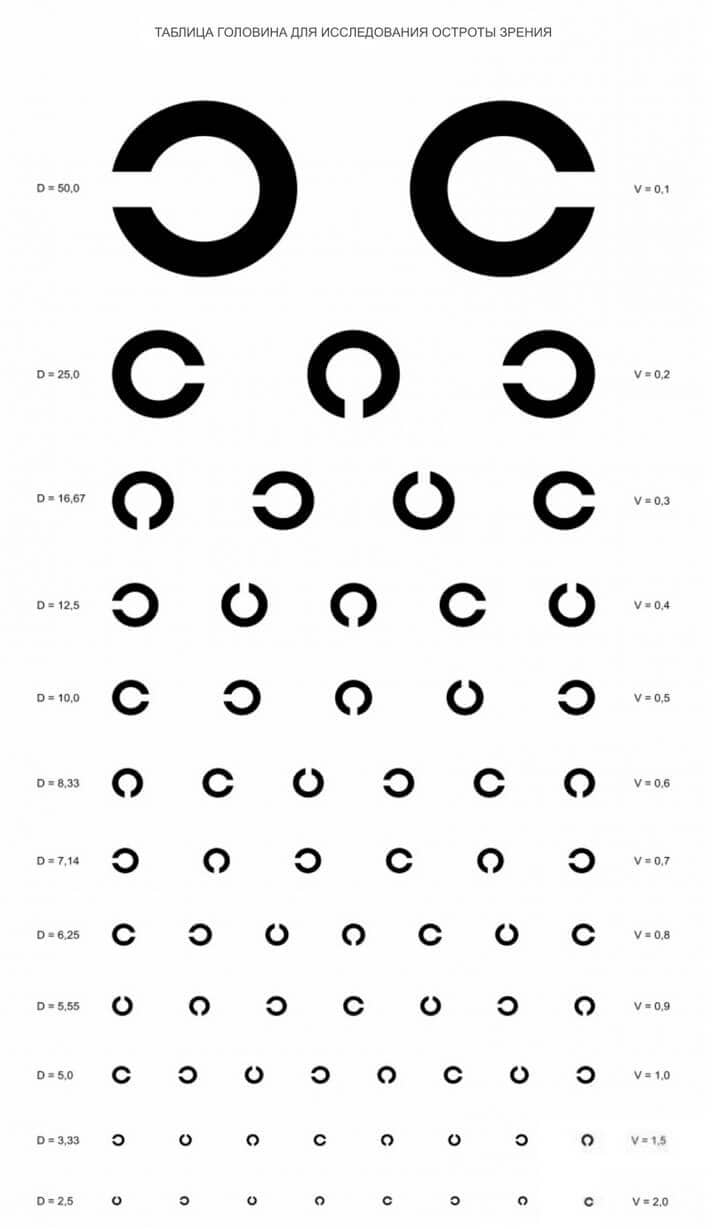
For eye exams, an оптометрическая таблица с буквами (eye chart with alphabet letters) is used. In countries that use Cyrillic, таблица Сивцева (Sivtsev’s Chart) is often used. Named after the Soviet ophthalmologist that developed it, this chart has only seven letters from the Russian alphabet: Ш, Б, М, Н, К, Ы, И. There is another chart, which is usually placed to the right of Sivtsev’s chart, named таблица Головина (Golovin’s Chart), pictured below right.
An окулист might ask the following questions to a patient: “Какую самую нижнюю строчку Вы видите?” (What is the smallest row (of letters) that you can read?), or “В какой линзе лучше видно?” (Which lens is clearer?). In the process of getting an eye exam, you may be asked to “Прислонитесьлбом к верхней части и положите подбородок на опору” (Put your forehead on the top part (of the machine). The patient is also likely to be asked to “поморгайте” (blink), “посмотрите вниз/вверх/налево/направо” (look down/up/left/right), “посмотрите прямо на меня” (look directly at me), or “посмотрите на стену за мной” (look at the wall behind me). The doctor may also refer the parts of the eye: зрачок (pupil), радужнаяоболочка глаза (iris), белки глаз (the whites of eyes), роговая оболочка (cornea), or слезныепротоки (tear ducts).
Заказывать очки (to order glasses) in an оптика, you should choose your оправа (frames) first. Then, линзы (lenses) will be created according to the рецепт (prescription).
If a person needs контактные линзы, he/she might also need to buy физраствор (saline solution) and a контейнер для линз (contact lens case). Contact lenses can be одноразовые/мягкие (disposable/soft), which you wear for a day then throw away, or постоянные/ жесткие (permanent/hard) which you use for longer periods – from several weeks to several months.
Unlike in America, you can get glasses without a doctor’s appointment in many Eurasian countries (although most shops will recommend that you see the doctor anyway). You just need to know your prescription. In larger cities, contact lenses are often sold from торговые автоматы (vending machines) located in malls and supermarkets.
Посещение врача (a visit to the doctor) is quite inexpensive although the glasses are often about the same cost as in America. Particularly for люди с астигматизмом (people with astigmatism), the lenses импортируются (are imported), often from factories in Japan, and can be relatively expensive.
In many traditional or preventive care settings, people are often encouraged выполнять упражнения для глаз (to practice eye exercises) before turning to glasses. These routines typically include переключение фокуса зрения (shifting focus) between near and distant objects, tracing shapes with the eyes, rapid blinking to reduce strain, and отдых для глаз в темноте (resting the eyes in darkness). Rooted partly in Soviet-era health culture, such exercises aim to укрепить глазные мышцы (strengthen eye muscles), снять усталость (relieve fatigue), and улучшить кровообращение (improve circulation), reflecting a broader preference for неинвазивные (non-invasive), self-managed approaches to maintaining vision. Such methods are especially common for children in Russia and other former Soviet countries where obligatory eye exams are given in all schools.
Home Treatments
There are many гомеопатическое лечение (homeopathic treatments) and народные средства (folk remedies) for different illnesses which might be new to students who encounter them abroad.
As in many countries, чай (tea) is a common treatment for many illnesses. Sometimes these are regular teas and sometimes can be отвары (brews; medicinal teas) from специи, травы или другие ингредиенты (spices, herbs, or other ingredients).

To treat some stomach ailments, чайный гриб (kombucha; lit: mushroom tea) is sometimes used. While the drink is relatively new to America, it has been known for centuries in much of Eurasia, including most SRAS locations.
For insomnia or stress, natural успокоительные средства (sedatives) such as мед (honey), молоко (milk), ромашка (chamomile), тмин (caraway), имбирь (ginger), and шалфей (sage) can act as снотворные (soporifics, or drugs that induce sleep or a sense of calm). These might be taken as drinks or added to food.
Many of these same ingredients are used for treating sore throats and colds. Hot drinks with ginger, lemon, and/or honey can be seen as the chicken noodle soups of this geographic area. They дезинфицируют (disinfect) the throat, укрепляют иммунную систему (boost the immune system), and calm the mind.
Also common are полоскание (gargles). The simplest of these contains 1 teaspoonful of salt per glass of warm water for a gargle every thirty minutes. This also disinfects the throat. One can also add one or two drops of iodine to the solution to make it stronger. Or, herbs such as sage or chamomile might be boiled and can be used as a warm gargles after they have cooled somewhat. Sage and chamomile also have antibacterial properties.
There are more экзотические средства (exotic remedies) as well. Some locals might recommend a shot of vodka, or even водка с добавлением перца (vodka with pepper added) which definitely disinfects the throats and shocks the system. Hot milk with honey (generally two tablespoons of honey per glass of milk) is often recommended as a way to sooth the throat although the milk can act as a bacterial agent and thus might not be advisable.
Some might suggest a йодная сетка (iodine net, sometimes referred to as “iodine painting” in English). This involves iodine being used to make a crisscross pattern across the throat, usually before sleep. The idea is that the iodine will draw out some inflammation from the throat to improve breathing and comfort.
Some might also suggest that you массировать грудь (apply a chest rub). Горчица (mustard) is commonly used for this as a sort of Vicks VapoRub – it creates a sensation of heat on the chest and creates fumes meant to clear the sinuses. For this, “Russian mustard,” which is strong, brown, and thick, is usually used. One can also buy горчичники (mustard plasters) in some pharmacies – which are essentially ground mustard seeds in large tea bags. They are heated and used as compresses. However, one should be careful with this as, if applied too strongly and/or for too long, it can burn the skin.
Another, rarer, but still found suggestion would be to rub сало (lard) on one’s chest. Other vodka remedies exist as well, such as водка с мёртвыми пчёлами. Most bee products are considered healthful in Russia and can be found in the health food stores such as соты (honey comb) and пыльца (pollen), so somebody probably decided at some point that the bees’ bodies themselves are probably sources of health. We are not sure what either сало on your chest or водка с мёртвыми пчёлами down your throat does besides give you a really good story to take home. However, some people, especially older people, swear by these treatments.
For headaches, folk wisdom says that you may crumple a fresh капустный лист (cabbage leaf) and affix it to your forehead and/or temples with a bandage. Another might be applied to the back of the neck. Cabbage is rich in ионы кальция (calcium ions) that can normalize the blood vessels under the skin, which can облегчить (alleviate) many types of headaches.
Another common treatment that was borrowed from traditional Chinese medicine, common in Soviet treatments, and still found in many Eurasian clinics today is “баночный массаж” (“cupping”). This “massage” uses heated cups or jars placed on the skin. As the air in the jars cools, a vacuum is created, который притягивает кровь к поверхности кожи (which forces blood to the surface) and creating a large, pronounced синяк (bruise) similar to a засоса (hickey). Practitioners argue that this can be used лечить боли в мышцах и суставах (to treat sore muscles and joints), нервные расстройства (nerve disorders), заболевания дыхательных путей (respiratory disorders), as well as some skin issues including целлюлит (cellulite). Some will argue for its effectiveness in a much wider array of diseases and disorders, including «балансировки биоактивных зон» (“balancing bio-active zones”) and generally укрепить иммунитет (strengthens immunity) — although modern science has found никаких доказательств (no proof) that the treatment causes anything but bruising and, on occasion, burns when the cups are not heated properly.
Seek Treatment, Use Common Sense
Students seeking healthcare abroad should ideally check with their insurance to see which providers are recommended before visiting a doctor. They should also be prepared for culture shock within the medical system. Medicine differs abroad – often it is just as effective and can be even more effective – it’s just that recommended procedures and treatments can vary. As in any medical situation, make sure that you discuss and understand your treatment options with your doctor and voice any concerns you may have early on. Students on SRAS programs can always consult with their program coordinator, who can also accompany the student to a clinic to assist with translation and making sure everything is understood.
You’ll Also Love
Orthodox Easter: Its Language and Symbolism
Orthodox Easter is by far the most important religious holiday in most Slavic lands and is the busiest day at most Russian Orthodox churches across the globe. The holiday is steeped in history and mystic symbolism. The following is a dual-language article meant to teach you about history and culture of Orthodox Easter while allowing […]

Translation Challenges in Russian
Translating between any two languages can be difficult, and translating between Russian and English is no exception. Due to certain grammatical differences, some meanings within the languages can be difficult to translate. While such differences between English and Russian that affect accurate translation are numerous, below are six of the most interesting in our opinion. […]
Russian MiniLesson: The Russian Soul and Related Russian Vocabulary
Many well-known people from various countries have acknowledged that Russia and the Russians have unique features that can be difficult to explain. For example, British Prime Minister Winston Churchill once said that “Россия – это головоломка, завернутая в тайнувнутри загадки” (Russia is a riddle wrapped in a mystery inside an enigma). A part of this mystery is […]

Russian Vocabulary about Love and Relationships
Russian has many ways of expressing affection and describing the various phases of falling in love and establishing a relationship. This bilingual resource is meant to build your vocabulary by providing Russian phrases within English text. It covers everything from meeting to dating and marriage and in multiple styles from slang to classical literary prose. […]
Самый лучший разговорник – The Best Phrasebook Ever
The following list of phrases are meant as educational humor. Some are just silly, some are useful, some will be understood by all, and some only by those who have spent time in Russia. Some of these have been around online as jokes for some time – others were added based on common experiences that […]